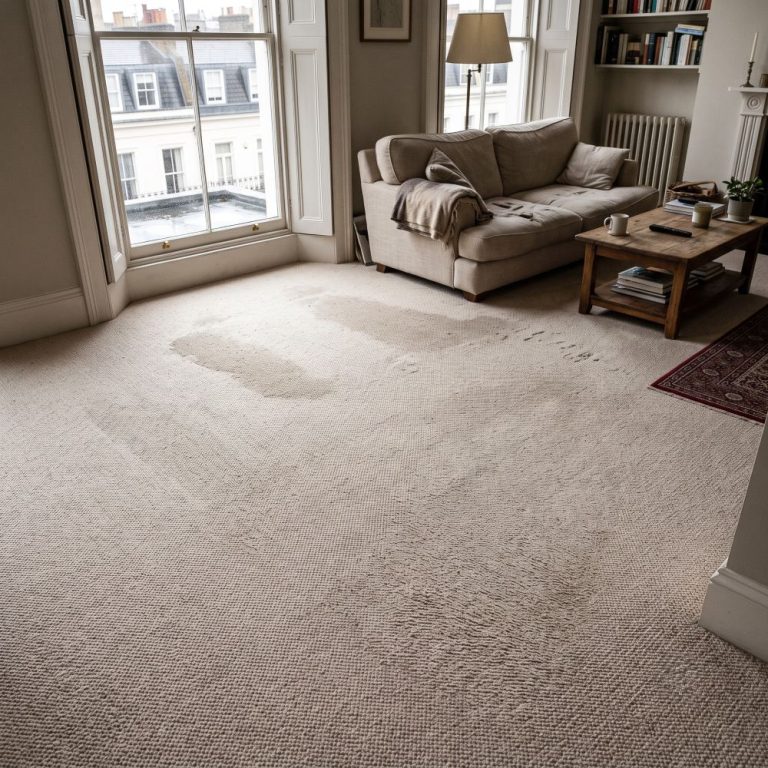
Most of the emergency calls I take are not emergencies. They are deadlines. A check-out inspection at nine tomorrow, a mother-in-law arriving Friday, a viewing that the agent has already confirmed. The genuine emergencies – the ones where waiting causes damage rather than embarrassment – arrive maybe twice a month, usually as a burst flexi-hose under a kitchen sink, and they need something quite different from a carpet clean. Both sets of callers ask the same question, which is whether it can be done today, and the answer depends far less on my diary than on how long water takes to leave wool.
What does same-day mean once the van is already loaded?
Any established firm is booked three to eight days out in spring and autumn. A same-day slot therefore exists in one of three ways: a cancellation, an overtime evening, or a job squeezed into the gap between two others in the same corner of London.
The last of those is the one worth chasing. If I have a morning in Deptford and an afternoon in Camberwell, a twenty-minute job between them costs me almost nothing in travel and I will take it at close to normal rates. The same request from Ruislip on the same day is a two-hour round trip through traffic that pays for nothing, and either I decline it or I charge in a way that makes the caller wince.
The upshot is that same-day availability across Greater London is a geography question rather than a service level. A firm covering the whole of the M25 has vans somewhere, and the honest version of the phone call is somebody asking which borough you are in before they answer. Anyone who says yes to a same-day slot in Muswell Hill without asking where their nearest van is has either got nothing booked at all, which raises its own question, or is planning to arrive at ten past eight in the evening.
The two slots that are always free
Half past seven in the morning and half past six in the evening. Nobody books them, everyone can work them, and if you ring at eight on the day you want the work done, those are the openings you are being offered even when the person on the phone says “let me just check”. The evening one carries a cost you should know about: a carpet cleaned at seven in the evening in a flat with the windows shut dries in something like fourteen hours, not five, because the air stops moving and the temperature drops overnight. You will get a clean carpet and a damp Wednesday.
How long before the carpet is dry enough to put the furniture back?
Two to six hours on a well-extracted synthetic carpet in a ventilated room. Eight to twelve on wool. Longer on a heavy pile over rubber-crumb underlay, longer again in a basement flat in Clerkenwell in November with sealed windows.
Dry enough to walk on in socks and dry enough for furniture are separate milestones, and people conflate them constantly. The carpet surface dries first. The backing and the underlay hold moisture for hours after the pile feels fine, which is why a sideboard put back at teatime leaves a rust mark by morning.
The dehumidifier does the work the fan gets credit for
Air movers shift moisture off the fibre and into the room. If the room air is already at 70% relative humidity, the moisture has nowhere to go and the fan is stirring a warm damp soup. A refrigerant dehumidifier pulling twenty litres a day, with the door shut and one air mover angled low across the pile, halves the drying time on a soaked room. That combination – hired for £40 a day from most tool shops – is the single most useful thing a homeowner can do without a technician present.
Which emergencies can wait until tomorrow, and which cannot?
This is the part that matters, and it splits by what the water is.
Clean water from a supply pipe or a radiator is the forgiving case. It carries no contamination on arrival, and a carpet caught within a few hours can usually be extracted, lifted, dried in place over its underlay and put back down with nothing lost. That job has a window of roughly twenty-four hours before the bacterial count in the water changes what you are dealing with.
Water that has passed through a ceiling, sat under a washing machine, or come up through a floor from outside is a different problem. Plaster dust, detergent residue and whatever is living in the void all end up in the pile. Past forty-eight hours in a warm flat, mould begins colonising the underlay and the timber beneath it, and no amount of extraction reverses that. The underlay comes out. There is no version of this where a same-day carpet clean is the right response, and a contractor who turns up, sprays a deodoriser and leaves you with a dry-looking floor has sold you a fortnight of quiet before the smell arrives.
Grey water from a dishwasher or a washing machine sits between the two. It carries detergent, food protein and enough bacteria to smell within three days, and it wants extraction plus an antimicrobial and a fast dry rather than a skip. Caught inside twelve hours it usually survives. Left over a weekend in a warm flat, the underlay is finished even where the carpet is fine, and that partial replacement is the awkward conversation because the customer can see a carpet that looks perfectly serviceable.
Sewage – a backed-up soil stack, a toilet overflow that has passed the trap – ends the conversation. The carpet and underlay go in a skip. I have had that argument in a ground-floor flat in Barking with a landlord who wanted it “just cleaned and sanitised”, and I lost it, and eight weeks later the tenant’s GP was writing letters about the smell. Nobody won anything.
The 24 to 48 hour window on soaked underlay
Underlay is a sponge with no ventilation on either face. Foam holds water for days; rubber crumb holds it longer and starts to break down and stain the carpet backing from below. The practical rule is that if the underlay has been wet for two days, replacing it costs less than the drying equipment hire required to save it, and it removes the risk entirely. Nobody enjoys hearing that on the day, and it is the correct advice roughly nine times out of ten.
What cannot be rushed regardless of who you pay?
Urine. The enzyme needs hours of contact time at the right temperature, and if the deposit has reached the floorboards the treatment schedule runs over two visits. Same-day urine work on a heavily soiled area produces an improvement and a promise. I have never once cleared a bad cat contamination in a single visit, and anyone claiming otherwise on the phone is quoting on the assumption that the damage is smaller than you described. Half the time it is larger.
Old set stains have a similar honesty problem. A red wine mark from Christmas has oxidised into the fibre, and lifting it means a reduction step and a rinse and sometimes a bleach-and-redye that no reputable person performs in a rush. Viscose gets one method and one only, and hurrying it turns a rug yellow along every line the wand travelled.
Wicking, and why the stain came back by teatime
A stain that has soaked into the backing travels back up the fibre as the carpet dries, reappearing on the surface as a soft brown halo three to five hours after the technician left. It is the most common complaint on rushed jobs, and the cause sits in the drying rather than the cleaning: too slow a dry, too much residue left in the backing. The fix is a second pass once dry, or a weighted absorbent pad left overnight. Both of those need a return visit. A same-day booking on a badly contaminated area is buying the first half of a two-part job.
What is the emergency premium buying you?
Between 30% and 100% on top of the standard rate, and I would be honest that most of it is scheduling rather than skill. I am moving other people’s bookings, working past six, or driving across London at the wrong time of day. The cleaning is the same cleaning.
Where the money is well spent is on the water-damage side, because that work needs equipment nobody keeps at home – moisture meters that read through the backing, thermal imaging to find how far the water tracked under the skirting, hire dehumidifiers, and an insurer-friendly moisture log. A firm turning up to a burst pipe in Surbiton with a truckmount and a stack of air movers is worth every penny of the callout, and the insurer will usually pay it directly once the first moisture reading is logged.
When to spend the money elsewhere
Here is the advice that costs me work. If the deadline is an inventory check-out, ring the agent and move the inspection by a day. Every check-out clerk in London knows that a carpet cleaned that morning will read damp on a meter and look darker than it will in twenty-four hours, and several of them will mark it down for exactly that reason. You will pay me an evening premium for a result that scores worse than the same job done on a Tuesday afternoon.
The exception is contamination, where speed changes the outcome by itself. Everything else is a diary problem wearing an emergency costume, and the cost of solving it that way lands on the customer rather than on the calendar that caused it.
By teatime tomorrow the carpet will be dry either way. The question is only which of those two days you paid a premium for.