The question arrives about once a fortnight, usually from a leaseholder who has just opened a service charge demand and found a line for stair carpet cleaning that has doubled. Somebody instructed the work. Somebody else paid for it. A third party is being invoiced. In almost every London block those are three different people, and the confusion between them is what allows a £180 job to appear on a budget at £340 without anybody being able to say precisely why. I clean communal stairs across a fair spread of Greater London, and the pattern is consistent enough that it is worth setting out plainly.
Who is legally responsible for cleaning the common parts?
The lease decides it, and in the overwhelming majority of flats the structure runs the same way. The freeholder covenants to maintain, clean and light the common parts. The leaseholders covenant to reimburse that expenditure through the service charge, split by whatever percentage sits in the schedule to their lease. The freeholder carries the obligation. The leaseholders carry the cost.
That is why the question of who pays has a slightly annoying answer: everybody, in sequence. The freeholder pays my invoice, then recovers it. What varies between blocks is the honesty and the arithmetic of that recovery.
Where a right to manage company changes the picture
In a block that has exercised right to manage, or in one where the leaseholders own the freehold through a residents’ company, the management obligation transfers to a company that the leaseholders themselves are directors of. They instruct me, they pay me, and they recover from themselves. Every consultation requirement that binds a commercial freeholder binds them too, and directors who assume otherwise generate the most expensive mistakes I see, because the company has no third party to absorb an irrecoverable cost.
Why does the managing agent instruct the work but never pay for it?
The agent is an agent. They act for whoever holds the management obligation, and their name on the purchase order carries no personal liability for my fee. The relationship matters because it determines who I chase when a bill sits unpaid for ninety days, and the answer is usually a client account rather than a person.
Where it gets interesting is the mark-up. Some agents pass my invoice through at cost and take their fee from the management charge. Others hold a supplier arrangement and add a percentage before the figure reaches the service charge account. Both are lawful where the lease permits recovery and the total remains reasonable. Only one gets disclosed as a matter of course.
The 15% that nobody puts on the job sheet
Fifteen per cent is the figure I hear most often, occasionally twenty, applied to contractor invoices as a supervision or procurement charge. A leaseholder in Sydenham asked her agent for the underlying invoices after a communal cleaning line jumped from £1,100 to £1,600 in one budget year. The contractor’s own figure had risen by £90. The rest was the percentage moving with it, plus a schedule change from quarterly to bi-monthly that no leaseholder had been told about. She got a partial credit and a very cold letter. What she never got was a job sheet, and no agent I have worked for in twelve years has volunteered one without being asked twice.
When does a stairwell clean trigger Section 20 consultation?
This is the part that costs people money, and cleaning contracts get missed more often than any other category.
Two thresholds sit in Section 20 of the Landlord and Tenant Act 1985, as amended in 2002. Qualifying works – one-off jobs to the building – require consultation where the cost to any one leaseholder exceeds £250 including VAT. Qualifying long-term agreements – contracts running more than twelve months for services such as cleaning, gardening or maintenance – require consultation where the cost to any one leaseholder exceeds £100 a year including VAT.
Both figures apply per leaseholder rather than to the total spend, and where service charge percentages differ across a block, the test is the flat paying the largest share. In a six-flat conversion in Woodford Green, a three-year cleaning contract at £700 a year lands each leaseholder somewhere near £117. That is a qualifying long-term agreement. Consultation is required. Almost nobody consults. Cleaning sits in the category of routine housekeeping in most people’s heads, and routine housekeeping does not feel like the sort of thing that needs three statutory notices and a thirty-day observation period. The regulations take no view on how it feels.
The penalty is severe and often misunderstood. Where consultation has not been carried out properly, the amount recoverable from each leaseholder is capped at £100 a year for a long-term agreement, or £250 for qualifying works, no matter what the contract actually cost. The shortfall lands on the freeholder or, in a right to manage block, on a company owned by the same leaseholders who successfully objected. The First-tier Tribunal can grant dispensation, and does, though not reliably and not without cost.
The twelve-month workaround every agent knows
Contracts written for twelve months or less, notice periods included, fall outside the long-term agreement definition entirely. This is why so many block cleaning contracts are annual rolling arrangements rather than three-year terms, and it is a perfectly legitimate structure. It also explains why an agent will resist a longer contract even when a contractor offers a better rate for one, which leaves leaseholders paying a slightly higher price for a slightly simpler process.
A separate trap catches the one-off jobs. A single deep clean of stair carpets in a block of forty flats will not come near £250 a head. The same job in a converted house in Stoke Newington with three flats and a £900 quote puts every leaseholder at £300, which is a qualifying work. Small blocks trip the threshold far more easily than large ones, and the directors of small blocks are the least likely to know it.
What happens when one leaseholder makes the mess?
Builders’ dust down four flights after a kitchen refit, a burst radiator on the top landing, paint trodden from the third floor to the entrance door. These get treated as general service charge expenditure far too often, which means the other five flats subsidise one flat’s building work.
Most modern leases contain a recharge provision covering damage caused by a leaseholder, their contractors or their visitors. Where it exists, the cost should be invoiced to that flat directly and kept out of the communal budget. Where the lease is an old one and contains nothing of the sort, the agent has very little to work with beyond persuasion, and the cost is shared whether or not that feels fair.
The practical fix is procedural. Blocks that require notification of internal works, take a refundable deposit against communal damage, and photograph the stairwell before the first delivery arrive at a defensible position without needing a lease clause at all. The ones that discover the problem eleven weeks later end up arguing from memory.
The after-builders clean nobody put in the budget
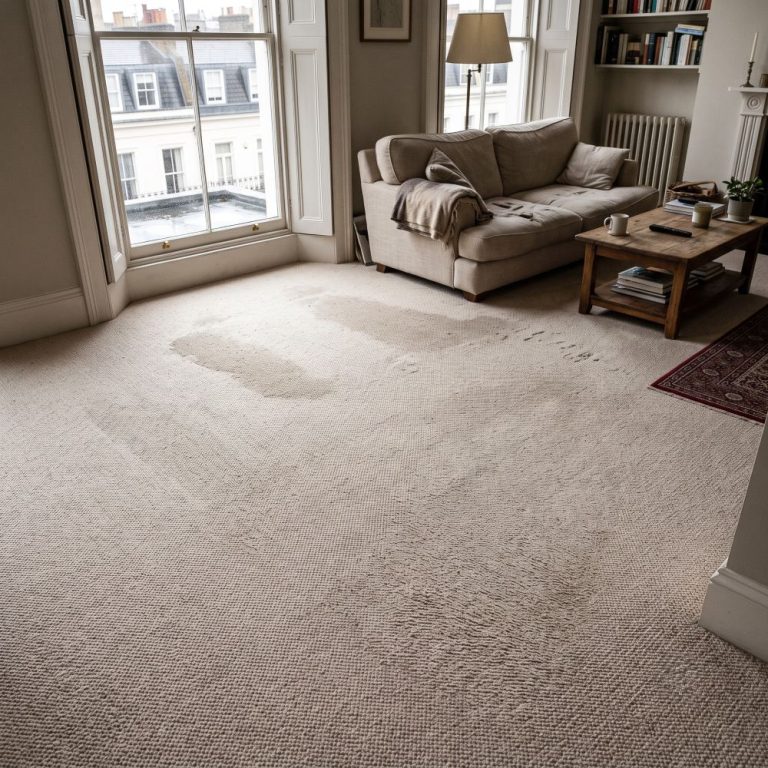
Fine plaster dust settles into a stair carpet and works its way down to the backing, where a domestic vacuum cannot reach it. Left there, it grinds the fibre with every footstep and greys the whole flight within months. I did a job in Hendon where a flat’s refurbishment had run for eleven weeks and the communal carpet had never been protected. Two passes with a high-filtration vacuum and hot water extraction brought it back. The invoice was £420, the leaseholder responsible paid it, and the only reason the argument stayed short was that a director had photographed the stairwell on the day the skip arrived.
Should a communal stairwell have carpet at all?
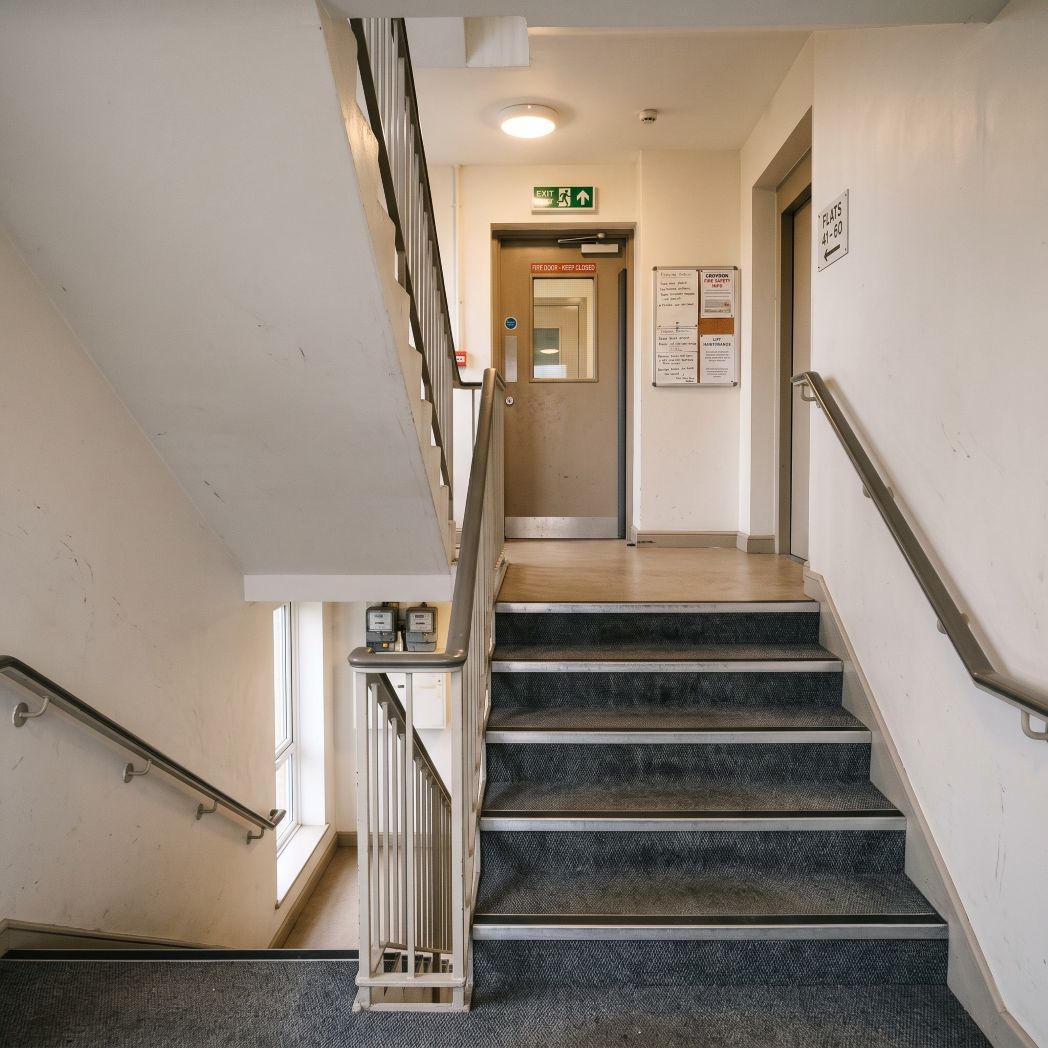
Now the part that costs me repeat business. In most London blocks, carpet on a communal stair is the wrong specification and should be removed at the next major works cycle.
The reasoning is arithmetic. A stairwell carpet in a busy block needs cleaning three or four times a year at £150 to £250 a visit, and it still looks tired by year seven because traffic lanes and edge soiling are unavoidable where every resident walks the identical line. Call it £700 a year, plus a replacement cost of £3,000 to £5,000 every eight years or so. Hard flooring with a properly specified entrance matting system at the door costs more to install and then costs a mop.
There are decent arguments the other way – acoustic performance in a converted house with timber stairs is a real one, and older leases sometimes specify carpet in terms that make removal a consent question. Fire performance is a separate consideration entirely, since anything laid on a protected escape route needs to meet the flame spread requirements of the building’s fire risk assessment, and that assessment governs regardless of what the leaseholders prefer.
What I would put down instead
Barrier matting at the entrance, running at least three strides’ worth rather than the ceremonial doormat most blocks install, then a commercial LVT or a sealed hard surface on the treads with a nosing that meets the fire risk assessment. Somewhere between eighty and ninety per cent of the soil arriving in a stairwell comes in on shoes, and three metres of decent matting removes most of it before it reaches the first step.
The blocks that fitted this in New Malden and on the Isle of Dogs stopped calling me every quarter. They call me for the entrance matting and the odd deep clean of what remains, which is less work at a better margin and produces a stairwell that looks respectable in year six rather than apologetic.
Ask for the job sheet before you argue about the invoice. It will tell you the date, the frequency, and whether the work described in the budget matches the work somebody carried out, which is a different question from whether the price was fair.