Two complaints arrive more often than any others after I have cleaned a loop pile carpet, and both of them predate my van. The first is a pulled loop running twelve inches across a landing. The second is a patch in the middle of a room that looks wet from one direction and dry from the other, and stays that way for the next four years. Customers reasonably assume that something which appeared after a clean was caused by the clean. Occasionally that is true, and I will get to the cases where it is. Mostly these two were settled the day it was laid, in the yarn and the fitting, and no cleaning method on the market either causes or cures them.
What makes Berber loop behave differently from a cut pile?
The pile is uncut. Each tuft goes into the backing, comes back out, and continues as a single length of yarn through hundreds of loops, anchored by latex rather than by being sheared into individual fibre ends. A cut pile is a field of separate tufts. A loop pile is closer to knitting.
Most of what gets sold as Berber in London is olefin – polypropylene – in a level loop or a multi-level construction, with wool loop at the upper end and a cheap bulked continuous filament at the lower. The yarn choice matters more than the price tag suggests.
Olefin, oil, and the traffic lane that comes back in a fortnight
Polypropylene is oleophilic. It has almost no affinity for water-based staining, which is why people love it, and a strong affinity for oils and greases, which is why the hallway goes grey again quickly. Body oils, cooking aerosol, and the film that comes in off London pavements bind to the fibre in a way that no amount of rinsing fully prevents recurring. A customer in Blackheath rang me eighteen days after a clean to say the traffic lane had returned. It had. That is the fibre doing what the fibre does, and the only real answers are entrance matting and a shorter cleaning interval.
What causes a snag, and why does it run?
A loop lifts because something hooks it – a claw, a stiletto heel, a vacuum beater bar set too low, the corner of a wardrobe dragged rather than lifted. The loop comes clear of the backing and stands proud. So far, a small problem.
The run is the structural part. Because the yarn is continuous, tension released at one loop travels along the row, and pulling the raised loop draws the neighbouring loops out with it in sequence. That is the ladder in a pair of tights, and it happens in the same way for the same reason.
Cleaning can expose a snag that was already there. A loop that has come loose but is sitting flat among its neighbours is invisible until a vacuum head or a cleaning wand lifts it into view, and the customer sees it for the first time on the day I leave. The distinction between causing and revealing sounds like an excuse until you watch it happen twice.
Scissors, and never fingers
Cut the loop flush with the pile surface using sharp small scissors. Do it the moment you see it. A drop of clear latex adhesive worked into the base with a cocktail stick stops the two cut ends retreating, and a repaired loop is invisible from standing height.
The instinct to pull is almost universal and it is the one thing that turns a two-second job into a fitter’s visit. I have watched a customer in Chiswick pull a raised loop while I was explaining not to, and take out fourteen inches of level loop in a single movement. That carpet had been perfect from the day it was laid in 2019 until roughly half past two that afternoon.
Is pooling something a cleaner can cause or cure?
Neither, and the honest technical answer is more interesting than the one the trade usually gives.
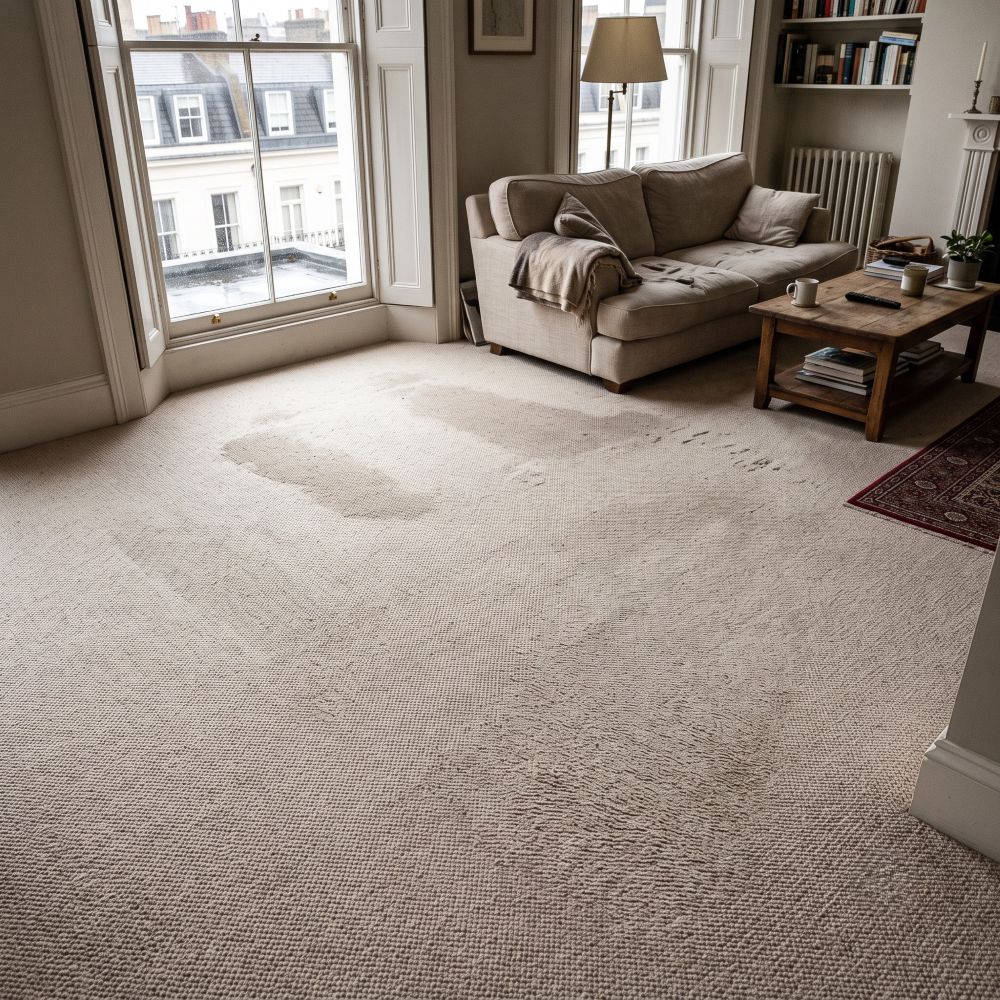
Pooling – pile reversal, watermarking, shading – is a permanent change in the direction the fibre lies. Light reflects differently off a reversed area, so it reads as a damp patch or a shadow with an irregular border that shifts as you walk round it. It appears most in dense cut piles, velvets and plushes especially, and in the cut-and-loop or textured constructions that get sold under the Berber name in half the carpet shops in London. A true level loop resists it well, which is one of the things it is good at. If your carpet was sold to you as Berber and it is pooling badly, turn back an edge and look at the tuft ends. A proportion of what London retailers shift under that name has been cut-and-loop since the mid-2000s, and the label followed the fashion rather than the construction.
Nobody has established a single cause. The candidates are moisture and heat cycling, underfoot compression, static charge, and variations in yarn twist and heat-set present in the roll before it left the mill. Manufacturers have investigated it for sixty years without agreement, and the position across the industry is that it is a characteristic rather than a defect. Almost no warranty covers it. No cleaning process reverses it – I have tried the pile lifting rake, the steam and brush approach, the lot, and the improvement lasts until the carpet dries.
Why it shows worst near a window or a radiator
Light at a low angle across the pile exaggerates any difference in fibre direction, so the same reversed area that is invisible under a ceiling light appears as a stain in morning sun through a bay. A flat in Wimbledon had what the leaseholder was certain was a permanent water mark from a leaking radiator valve. It was pile reversal, it had been there since before the leak, and she had never noticed it because the sofa had been in front of the window until the week the plumber came.
So what should a customer blame a cleaner for?
Plenty, and this is where I stop defending my own trade.
Overwetting is the big one. Too much solution and too little vacuum recovery leaves water in the backing, and on a loop pile that produces two consequences: latex delamination in the worst cases, where the secondary backing separates and the carpet ripples, and cellulosic browning where a jute or jute-blend backing releases tannins that travel up to the surface as a yellow-brown edge halo. Both are cleaning faults. Both come from a wand pass that was too fast or a machine without the recovery to lift what it put down. Loop pile hides moisture better than cut pile does, which is what catches people out: the surface feels dry to a palm within an hour while the backing is still holding water, and browning takes another twelve hours to show its face.
Residue is the second. A pre-spray that is not rinsed out leaves a sticky surfactant film in the fibre, and on olefin that film catches soil at a rate that makes the carpet dirtier eight weeks later than it was before the clean. Customers describe this as the carpet “never being the same after cleaning”, and they are describing a real thing that a rinse step would have prevented.
Distortion is the third. A rotary brush machine run over a level loop with too much pressure fuzzes the loops, breaking filaments and leaving a permanent hazy patch that never matches the rest of the floor. Shrinkage on a wool loop over a hessian backing, where the fitter left no room at the gripper, is a fourth, and it takes a fitter to fix.
The rotary brush argument I keep having
I hold an unpopular position on this: rotary brush agitation has no place on olefin loop pile, and the firms still using it are compensating for extraction equipment that cannot do the work on its own. A soft pre-spray, adequate dwell time, and a genuine rinse at temperature will out-clean brushing every time, without the fuzzing. Half the trade disagrees with me, and a good proportion of the hazy grey patches I get called out to inspect in Enfield and Sidcup arrived under a brush that a customer never saw running.
How do you keep a loop pile looking right for its lifespan?
Vacuum with suction, not with a beater bar. The rotating brush in an upright is designed to agitate cut pile and it is the single most common cause of snagging in domestic loop carpet. A cylinder machine or an upright with the brush disengaged does the job without the risk.
Matting at every external door, three strides deep. Trimmed claws on any dog that uses the stairs.
Dry soil removal does more for a loop pile than anything I do with a machine. Grit sits down between the loops where it cannot be seen, and every footstep grinds it against the filament until the yarn goes dull and stays dull. Slow passes, several directions, weekly in the hallway. A carpet fitted in Crouch End in 2014 that I have cleaned every couple of years still reads as almost new in the bedrooms and worn through in the hall, and the difference is entirely how often each floor met a vacuum.
Furniture is the other one. Lift it, never drag it, and use flat glides rather than castors on loop, because a castor concentrates the whole weight of a sofa onto a few loops and pulls them out of the backing over the months.
The setting nobody adjusts
Most uprights have a height adjustment that people leave on the lowest position because it feels more thorough. On a level loop it drags the brush bar through the loop tops. Raise it a notch, listen for the tone of the motor to lift, and you have removed most of the snagging risk in your house for the price of turning a dial.
A loop pile that has been vacuumed properly, cleaned without being drowned, and matted at the door will still shade near the window and will still take a snag off a stiletto in the hall. Those two were decided the day it was laid, in the yarn spec and the fitting, and the person who cleans it every eighteen months has no vote in either.